// case study
Workspace platform: infrastructure only code can change
An AI coding agent cannot change production except through a pull request that passes every required check, and a daily drift report proves it.
TypeScript · OpenTofu · NixOS · GitHub Actions · Docker · Bun · Cloudflare · Railway · Postgres · OpenBao · Playwright · Astro
Problem
The services behind this site and my side projects were first created by hand in provider dashboards. Nothing recorded what was supposed to exist, so drift surfaced when something broke. Once AI coding agents were doing most of the typing, an agent holding a credential could change production with no review at all.
Constraints
- Infrastructure changes only through declared code: no dashboard edits, no provisioning scripts, no provider calls from workflows.
- Live databases, buckets, tunnels and the secrets store must survive any plan, including a wrong one.
- Secrets never sit in the repository, in state files or in logs.
- The rules have to be enforced by machines, because agents do not remember them.
- Physical machines I own are defined by their operating-system configuration, not by cloud tooling.
Design
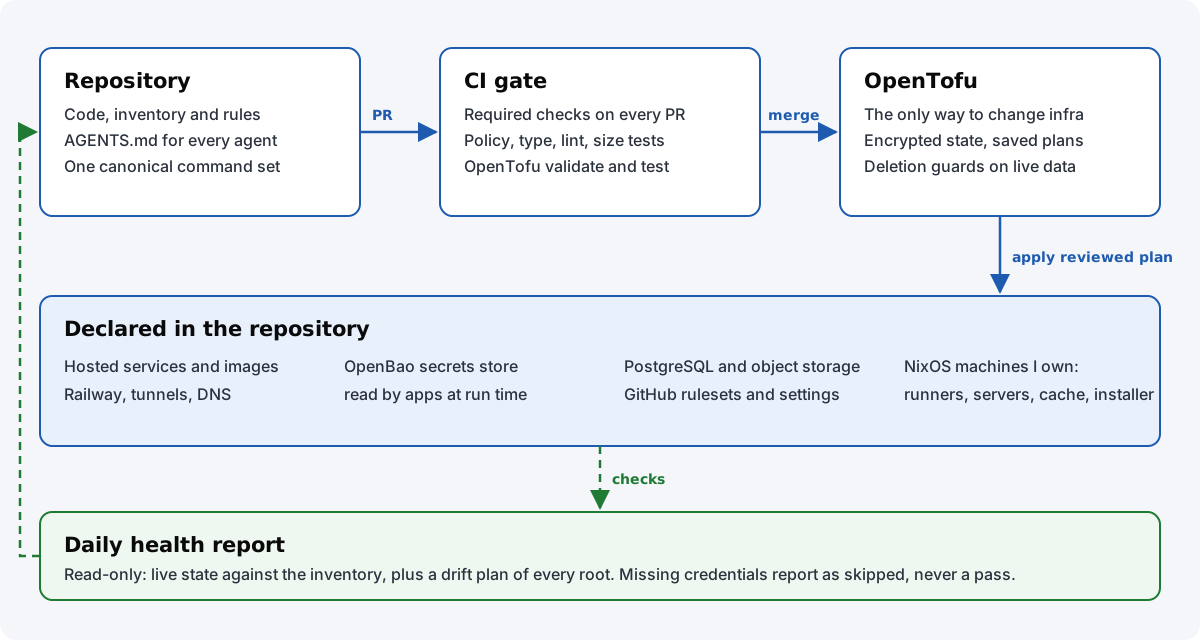
OpenTofu is the only provisioning tool. One inventory file declares every hosted service, and separate roots own state, the foundation, the bootstrap, the secrets store, sign-in and the runner fleet. State and plans are encrypted, and a change is applied only from a reviewed, saved plan. Existing resources were adopted by import, never replaced, and each root was verified with a plan that changed nothing.
OpenBao holds secrets, and applications read them at run time. Services are container images built in CI and deployed to Railway, and Cloudflare tunnels put access control in front of the internal ones. The CI runners, web servers, binary cache and network installer are NixOS configurations built from one pinned flake.
How correctness is enforced
Policy tests fail any change that adds a provisioning path outside OpenTofu, including cloud API clients in workflow files. Every root is formatted, initialized, validated and tested on each pull request, and live resources carry guards that stop even an approved plan from deleting them.
A daily read-only report compares the live platform with the inventory — DNS, TLS, services, tunnels, secrets, storage, images and runners — and plans every root to catch drift. A missing credential reports as skipped, never as a pass, and each failure comes with a guided fix that goes through OpenTofu or CI, never a provider dashboard.
The rules agents work under are written down in AGENTS.md, and one command set is synced to every agent harness the repository supports.
Outcome
The figures below are counted from the repository and its pull-request history by scripts that run in CI, so they move as the platform does.
- hosted services declared in one inventory
- 22
- OpenTofu roots, each validated on every pull request
- 9
- resources guarded against deletion
- 47
- health-check groups in the daily report
- 16
- CI jobs behind 2 required checks
- 12
- tests
- 1,253
- pull requests stopped by CI before merge, since 2026-09-17
- 21 of 102
- open issues
- 0
- latest run of its “CI” workflow on main; other scheduled workflows are reported separately on GitHub
- Green
Figures as of 2026-10-26.
What I would do differently
The policy test that forbids provider calls existed before an agent broke that rule, but a path filter skipped the check for that pull request. The full check now runs on every pull request; I would start that way.
The main-branch pipeline also deploys, so its pass rate mixes deploy trouble with code that failed review. I would report the two separately, so the number on the merge gate means one thing.